
Unlike ordinary tinted spectacle lenses or adaptive photochromic eyewear, the Light Architecture™ of ALTIUS® is precision-engineered. With over 25 years of research and development, these innovative filters not only control the brightness through their total tint immersion, but also through their targeted biological and neurological impact. ALTIUS® Lenses are designed to manage the quality and quantity of light reaching the eye, reducing “visual noise” caused by chromatic aberration and blue light overstimulation, while enhancing clarity, contrast, and target tracking.
In other words: ALTIUS® performance-tinted single-use soft contact lenses don’t just block glare, it builds a better visual environment for your brain to perform.
Both ALTIUS® tints, Amber and Grey-Green, utilize FDA-cleared Light Architecture™, offering 100% UV absorption and blocking over 99% of blue light (<500 nm) through full 360° total tint immersion. This uniform and complete coverage eliminates peripheral light leakage, surface reflections, and distortion common with spectacles, ensuring uncompromised performance and protection across the entire visual field.
What distinguishes ALTIUS® Amber is its calibration for 50% visible light transmission (VLT), a balance that reduces excessive light without over-dimming the visual field.
This makes it ideal for dynamic, reactive sports like baseball, tennis, and football, where rapid target tracking and contrast recognition are essential. By reducing chromatic aberration by 53%, Amber minimizes “visual noise,” allowing for sharper image formation and faster visual processing.
ALTIUS® Grey-Green’s 38% visible light transmission (VLT) makes it ideally suited for outdoor environments with intense glare, such as on water, turf, or pavement. Athletes and active individuals benefit from enhanced visual comfort, improved contrast, and reduced visual fatigue in bright, high-glare settings.
Traditional spectacle tints such as FL-41 only partially block blue light and allow light to reach the eyes from around or behind the spectacle frame. On the other hand, ALTIUS® Grey-Green and Amber soft contact lenses block over 99% of blue light (<500 nm) and allow no light to enter the eye other than through the lenses.
Clinical surveys show that when worn during migraine attacks, ALTIUS® Grey-Green users report:
Reports from users who suffer from photophobia due to traumatic brain injury, concussion, and other conditions suggest similar favorable results when using either tint.
Both ALTIUS® Grey-Green and Amber spectral transmission profiles are meticulously tuned to the human visual system.
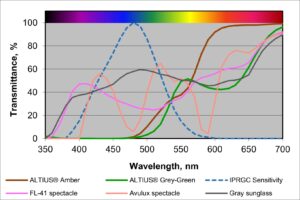
As shown in the above Figure ALTIUS® filters nearly all violet and blue wavelengths, including virtually all energy related to iPRGC Sensitivity, while selectively transmitting narrow-band green light (~550 nm). Burstein’s research identifies this wavelength as uniquely beneficial, it reduces cortical hyperexcitability and evokes calming emotional responses during migraine episodes.
By modulating these neural responses, ALTIUS® Light Architecture™ minimizes pain activation while supporting balanced visual and emotional perception, truly architecting light for neurological wellness.
Traditional flat or spectacle lenses leave the eye exposed to stray peripheral light, a limitation overcome through the evolutionary progression of curved, high-wrap designs pioneered by industry leaders from Nike MaxSight™ to today’s ALTIUS® Light Architecture™ system.
With complete corneal coverage, ALTIUS® achieves the ultimate in light management, merging optical precision with clinical protection, from performance vision to migraine management, post-concussion care and TBI recovery.
With availability in both corrective and non-corrective (Plano) powers, ALTIUS® is truly for EVERYONE.
ALTIUS® Light Architecture™ redefines how eye care practitioners and patients address photosensitivity.
Related information:
As demonstrated in Burstein et al.’s seminal Neurobiology of Photophobia (J Neuro-Ophthalmol, 2019), photophobia is not merely discomfort, it’s a neurological condition involving overstimulation of intrinsically photosensitive retinal ganglion cells (ipRGCs). These specialized retinal cells connect visual input to pain-processing centers in the thalamus, amplifying headache pain and emotional distress.
Use of ALTIUS® Single-Use Performance-Tinted Contact Lenses During Water Activities(2024)
Use of Performance-Tinted Contact Lenses in Patients with Photosensitivity (2024)