
When we think about vision, most people assume that “perfect” means 20/20.
But step into the real world, on the field, on the water, or under bright lights and that definition quickly falls short. Because vision isn’t just about clarity. It’s about how efficiently your brain processes light, contrast, movement, and glare.
And that’s where things break down.
Athletes miss critical details in motion. Patients with light sensitivity experience discomfort or even migraines. Everyday activities become more challenging under harsh or changing lighting conditions.
The reality is simple:
Everything starts with what you're seeing versus what you think you’re seeing.
Dr. Alan Reichow
For decades, contact lenses have served one purpose: vision correction.
ALTIUS® changes that paradigm.
You can benefit from ALTIUS® even if you don’t use a vision correction. In fact, more than 75% of ALTIUS® Lenses are prescribed in plano (= zero power / non-correcting) a clear signal that patients and athletes are seeking something more:
✔ Better visual performance
✔ Greater comfort in bright conditions
✔ Relief from light sensitivity
Even individuals with “perfect” vision still struggle with:
These aren’t vision correction problems. They’re light management problems.
ALTIUS® confronts these challenges at the source: light itself. Using proprietary Light Architecture™ Technology, ALTIUS® lenses are engineered to:
The result?
A more efficient visual system that allows you to:
See Better. Feel Better. Perform Better.
Sources:
We are honored to be featured in the March 2026 edition of Vision Monday, and we extend our sincere thanks to Sarah McGoldrick for highlighting ALTIUS® and the work behind our mission.
The feature captures a powerful conversation with our CEO, Dr. Alan Reichow, OD, MEd, FAAO, whose decades of research have helped shape the modern field of performance vision.
From early innovations that led to globally recognized sports vision technologies to the development of ALTIUS®, Dr. Reichow’s work has consistently focused on first and foremost optimizing the quality of the visual signal.
As he shared in the article:
“Vision, the guiding sense for most of human performance, is first and foremost dependent upon the quality of the visual signal leaving the eyes to the brain to better enable the most efficient and accurate visual information processing. It all begins with visual clarity and contrast.”
This philosophy continues to guide ALTIUS® today.
There is a growing understanding that managing light is essential not only for protecting the eye, but for optimizing how well the brain processes visual information. This is where ALTIUS® stands apart: delivering a solution that bridges clinical need and performance enhancement through advanced light filtration.
We are proud to contribute to a future where eye care professionals, athletes, and patients alike recognize that visual clarity and contrast are a fundamental driver of how we feel, function, and perform.
Read the article: ALTIUS VisionMonday | Pages 86 and 88
As another baseball season begins, players face one of the most visually demanding environments in sports. Bright midday sun. Low-angle afternoon glare. Stadium shadows cutting across the infield.
In baseball, milliseconds matter and so does visual clarity.
From tracking a 90+ mph fastball to judging spin on a breaking pitch, your visual system must process fine detail in ever-changing light conditions. That’s where ALTIUS® Performance-Tinted Soft Contact Lenses CHANGE THE GAME. Even if you’ve never worn contact lenses, ALTIUS® were designed with every baseball player in mind, including those requiring no vision correction. ALTIUS® for Every Player.
Baseball is an extremely demanding dynamic, reactive sport that requires:
Research spanning over two decades shows that Performance-Tinted Soft Contact Lenses can dramatically improve visual performance in bright outdoor conditions*.
Early-season games create unique visual stress:
Standard sunglasses restrict peripheral vision, can fog, shift, and compromise performance during play. Clear lenses don’t filter harsh wavelengths that reduce visual clarity.
ALTIUS® Lenses were engineered specifically to solve these problems.
ALTIUS® Amber (50% Visible Light Transmission) is engineered for dynamic, reactive target tracking sports like baseball.
By reducing visual noise and filtering specific wavelengths, ALTIUS® enhances edge definition and contrast helping players with pitch recognition and seeing the ball’s seams, spin, and trajectory with greater precision. Outcome: University research with Collegiate baseball players demonstrated dramatic improvements in batting statistics.*
Trip Hannah
Tripp Hannah, a shortstop and pitcher from Yulee, Florida, is a top-ranked Class of 2026 prospect with a Perfect Game Grade of 10, placing him in the top 1% nationally. Signed with Oklahoma State for 2026–2027, he relentlessly pursues every competitive edge.
After adding ALTIUS® Amber to his game, Tripp shared:
"I have really good vision (but) I got the the point where I was struggling really bad, I couldn't see, especially during the daytime...I put them (ALTIUS) on and I walked outside and I instantly knew... the contrast was so easy to see. I wore them in a game and it was so much better right away."
Unlike ordinary tinted spectacle lenses or adaptive photochromic eyewear, the Light Architecture™ of ALTIUS® is precision-engineered. With over 25 years of research and development, these innovative filters not only control the brightness through their total tint immersion, but also through their targeted biological and neurological impact. ALTIUS® Lenses are designed to manage the quality and quantity of light reaching the eye, reducing “visual noise” caused by chromatic aberration and blue light overstimulation, while enhancing clarity, contrast, and target tracking.
In other words: ALTIUS® performance-tinted single-use soft contact lenses don’t just block glare, it builds a better visual environment for your brain to perform.
Both ALTIUS® tints, Amber and Grey-Green, utilize FDA-cleared Light Architecture™, offering 100% UV absorption and blocking over 99% of blue light (<500 nm) through full 360° total tint immersion. This uniform and complete coverage eliminates peripheral light leakage, surface reflections, and distortion common with spectacles, ensuring uncompromised performance and protection across the entire visual field.
What distinguishes ALTIUS® Amber is its calibration for 50% visible light transmission (VLT), a balance that reduces excessive light without over-dimming the visual field.
This makes it ideal for dynamic, reactive sports like baseball, tennis, and football, where rapid target tracking and contrast recognition are essential. By reducing chromatic aberration by 53%, Amber minimizes “visual noise,” allowing for sharper image formation and faster visual processing.
ALTIUS® Grey-Green’s 38% visible light transmission (VLT) makes it ideally suited for outdoor environments with intense glare, such as on water, turf, or pavement. Athletes and active individuals benefit from enhanced visual comfort, improved contrast, and reduced visual fatigue in bright, high-glare settings.
Traditional spectacle tints such as FL-41 only partially block blue light and allow light to reach the eyes from around or behind the spectacle frame. On the other hand, ALTIUS® Grey-Green and Amber soft contact lenses block over 99% of blue light (<500 nm) and allow no light to enter the eye other than through the lenses.
Clinical surveys show that when worn during migraine attacks, ALTIUS® Grey-Green users report:
Reports from users who suffer from photophobia due to traumatic brain injury, concussion, and other conditions suggest similar favorable results when using either tint.
Both ALTIUS® Grey-Green and Amber spectral transmission profiles are meticulously tuned to the human visual system.
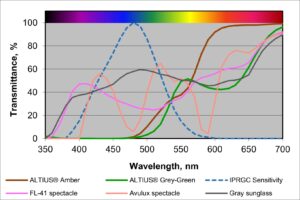
As shown in the above Figure ALTIUS® filters nearly all violet and blue wavelengths, including virtually all energy related to iPRGC Sensitivity, while selectively transmitting narrow-band green light (~550 nm). Burstein’s research identifies this wavelength as uniquely beneficial, it reduces cortical hyperexcitability and evokes calming emotional responses during migraine episodes.
By modulating these neural responses, ALTIUS® Light Architecture™ minimizes pain activation while supporting balanced visual and emotional perception, truly architecting light for neurological wellness.
Traditional flat or spectacle lenses leave the eye exposed to stray peripheral light, a limitation overcome through the evolutionary progression of curved, high-wrap designs pioneered by industry leaders from Nike MaxSight™ to today’s ALTIUS® Light Architecture™ system.
With complete corneal coverage, ALTIUS® achieves the ultimate in light management, merging optical precision with clinical protection, from performance vision to migraine management, post-concussion care and TBI recovery.
With availability in both corrective and non-corrective (Plano) powers, ALTIUS® is truly for EVERYONE.
ALTIUS® Light Architecture™ redefines how eye care practitioners and patients address photosensitivity.
Related information:
As demonstrated in Burstein et al.’s seminal Neurobiology of Photophobia (J Neuro-Ophthalmol, 2019), photophobia is not merely discomfort, it’s a neurological condition involving overstimulation of intrinsically photosensitive retinal ganglion cells (ipRGCs). These specialized retinal cells connect visual input to pain-processing centers in the thalamus, amplifying headache pain and emotional distress.
Use of ALTIUS® Single-Use Performance-Tinted Contact Lenses During Water Activities(2024)
Use of Performance-Tinted Contact Lenses in Patients with Photosensitivity (2024)
Sports media channels lit up recently when Los Angeles Chargers quarterback Justin Herbert was seen sporting red-tinted contact lenses during training camp. “They’re like sunglasses,” Herbert told reporters. “I didn’t have to squint nearly as much… When I stepped into the huddle, I think some of the guys were a little surprised. Think they were like, ‘Oh, we’re gonna score.’”
What Herbert was wearing? Performance-Tinted Contact Lenses. Precision-engineered with patents-pending Light Architecture™ technology, these single-use lenses are rapidly becoming the go-to visual enhancement for elite athletes in dynamic, light-intensive environments. Developed by the same inventors as Nike MaxSight, these lenses are the Next Generation.
Herbert’s choice didn’t go unnoticed. Major sports outlets like NFL.com, ESPN, Yahoo! Sports, The Sporting News, Chargers.com and others all reported on his red-tinted lenses, spotlighting their visual impact on-field.
If you want to experience what Justin Herbert is seeing, reach out to us and we’ll help connect you with an eye care professional Find a provider
Every day, millions silently endure a condition that’s often invisible to others but profoundly affects daily life. Photophobia, or light sensitivity, is a neurologically driven symptom that can cause debilitating discomfort. It frequently accompanies conditions such as migraine, traumatic brain injury (TBI), and post-concussion syndrome. For those affected, even everyday lighting can trigger significant pain and discomfort. Patents-pending ALTIUS® Performance-Tinted Single-Use Contact Lenses provide a non-medicinal solution to alleviate light sensitivity by filtering the harshest part of visible light and providing comfortable vision.
More than one billion people worldwide live with migraine, It is one of the leading causes of disability across the globe. Yet despite its scale, migraine and its debilitating symptoms, including light sensitivity (photophobia), often go unrecognized and misunderstood. This June, in honor of Migraine and Headache Awareness Month (MHAM), ALTIUS® proudly joins the call to “Make the Invisible Visible.” It’s time to elevate the voices of those affected by photophobia and bring their daily challenges and strength into the light.
Light sensitivity isn’t just a visual issue, it’s a quality-of-life issue. For those affected, everyday environments can become overwhelming. It can:
For many, the solution becomes avoidance, retreating from daily life because their eyes, and their nervous system, simply can’t tolerate the light.
For individuals affected by photophobia, ALTIUS® Grey-Green Performance-Tinted Contact Lenses provide a scientifically informed, non-medicinal solution for managing photophobia. In an internal patient survey, users reported:
Engineered with our proprietary Light Architecture™ technology, ALTIUS® lenses target the specific wavelengths that overstimulate intrinsically photosensitive retinal ganglion cells (ipRGCs)—key players in brightness regulation and light-triggered pain. By blocking 100% of UV and over 99% of blue light, ALTIUS® lenses reduce visual overstimulation while providing enhanced contrast for crisp, comfortable visual performance.
This June, during Migraine and Headache Awareness Month, we invite you to help bring light sensitivity and the millions affected by it into the light. ALTIUS® isn’t just a contact lens—it’s a tool for reclaiming comfort, restoring clarity, and elevating quality of life.
Whether you’re navigating migraines, recovering from a concussion, or living with chronic photophobia, know this: non-pharmaceutical relief from light sensitivity is possible.
Together, we’re a community. Together, we make it visible.
“I have noticed [ALTIUS] helps with light sensitivity so I can do things sometimes for longer and things I couldn’t enjoy doing on bright days. [ALTIUS] helps to improve my quality of life and to be able to do these things without having to avoid or close my eyes”
— Amy
"I don't wear them daily now, only as needed mostly for headaches or migraine attacks. I feel a sense of comfort if I should get a headache or migraine that I have an effective, non-medication means to bringing relief, usually weekly (1-3 days)"
— Stephanie, Clinical Pharmacist
“I felt a migraine coming on, put in the contacts and was able to enjoy a family event. It felt like it stopped the migraine in its tracks.”
— Sarah, Student
Our lenses are designed to provide greater visual performance, but they may also be a great recovery tool for anyone experiencing photosensitivity as a symptom of migraines, concussions, or traumatic brain injuries. Photosensitivity, and the lack of adequate options to treat it, often makes recovery from injuries like these more difficult. When we heard the inspiring story of Michael Hull, and how he found relief with ALTIUS®, we knew we had to share it.
Michael Hull is a husband and father to two young girls. To celebrate the momentous occasion of turning 40, he decided to start racing in Ironman competitions. He had done some extreme endurance training before jumping into this. He had already completed a dozen half marathons and 3 full marathons. But, the Ironman was the next level of challenge for him.
He completed two Olympic distance triathlons and a half Ironman, which includes a 1.2 mile swim, a 56 mile bike ride, and 13.1 mile run. He’s currently training for the full Ironman - 2.4 mile swim, 112 mile bike ride, and a full marathon run of 26.2 miles.
Not only was Michael consistently improving his time and enjoying the training and competition of the races, but his girls also loved it. It became a family event, everyone supporting dad as he challenged himself in these extreme endurance races.
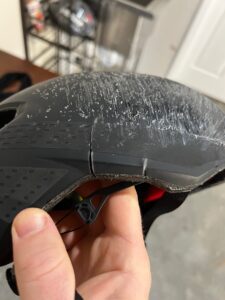
Everything changed on February 8, 2023. Just like any other day, Michael got up early before work to train. It wasn’t an intense session for him, just a relatively easy (for him) 90-minute bike ride. Well, that bike ride would be anything but easy.
Moving at high speed, he hit an unexpected bump that launched him off his bike. The accident resulted in a severely broken clavicle, which sent him into surgery shortly after. The doctors considered that he may have also had a concussion, but the immediate concern in those first few days was fixing the severely broken bone.
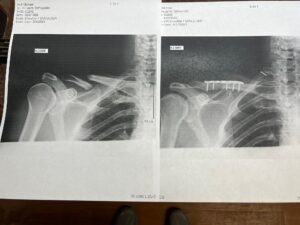

As his clavicle healed, Michael went back to life as usual - mostly. He went back to work. He spent time with his family. However, one week after the crash he was faced with unbearable pain in his head. Suddenly, he couldn’t look at screens. The sound of his young daughters walking around the house felt like thunder in his head. His head was heavy and doing most things became almost impossible.
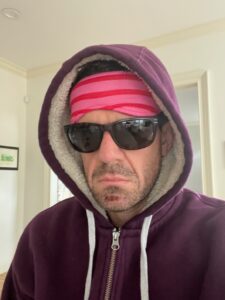
When his head started to hurt, the rest of his body went into stress. His low resting heart rate jumped up from low 50s to the 90s. He put his head in his pillow, wore sunglasses, eye covers, ear covers, you name it. He limited his time on devices because he just couldn’t handle the pain. It became difficult to work, and just to live his life.
The problem with concussions is that they’re a hidden injury, but often much more difficult than any other physical injury in terms of recovery. There aren’t a lot of options for treatment and they can go unnoticed and undiagnosed. For Michael, it was clear he was suffering from symptoms of a concussion from his accident. But, how could he find relief?
That’s when Dr. Kathy Weise came in. Dr. Weise is a professor and highly respected clinical and research optometrist at the University of Alabama at Birmingham. After prescribing ALTIUS lenses for many of her athletic patients for performance, as well as for photosensitivity related to migraines and concussions, she hoped that these lenses could provide the healing support Michael needed.
He had already started seeing an orthopedic doctor for concussion protocols, but nothing was giving him the relief he desperately needed - until he put on the ATLIUS lenses. He tried covering his eyes with sunglasses, but the light leakage that inevitably happens with sunglasses doesn't allow for a full relief from light. With ALTIUS lenses, your eyes are completely covered with the protective lenses that filter out all of the UV, and block out the harsh blue light that may have been the triggers for the pain and irritation that Michael was experiencing.
Now, Michael was not a contact lens wearer. Wearing contact lenses was foreign to him, but he was willing to try anything to feel better. He describes the feeling of the lenses as instant relief. It felt like a security blanket. Finally, he could feel the release of the pressure in his head. He could see, he could drive a car, he felt calm for the first time in weeks.
In addition to the feeling of relief Michael experienced, Dr. Weise likes the ALTIUS lenses for another reason. As an unexpected benefit, the grey-green or amber ALTIUS lenses are more visible on the eye than clear contact lenses. While the ALTIUS lenses provide protection and relief for the user, they are also readily apparent to others around them. As Dr. Weise explains, because concussions are invisible injuries, friends and family of a person who has had a concussion aren’t always aware of the extent of debilitating symptoms the sufferer is experiencing. There may be feelings of brain fog, light sensitivity, fatigue, headache, and dizziness. However, since there is no cast, sling, or splint for a person’s concussed head, many others fail to recognize a person who is trying to heal his or her injured brain. The amber or grey-green coloring provides a visible indicator to others that the concussed person requires treatment to aid in concussion recovery.
For 3 weeks straight, Michael wore the daily disposable lenses. He wore them to work, he wore them around the house, he wore them until right before he fell asleep at night. He tried not wearing them, and immediately felt the pain in his head resurge. He’d feel nauseous, and the headache and heaviness in his head would return. It was clear that these lenses were exactly what he needed to feel normal again and allow his head to heal.
After those 3 weeks, Michael returned to life as normal. Even though he no longer felt like he needed the lenses for relief from his concussion symptoms, he did continue to wear the lenses for other reasons. When describing the accident itself, he believes it could have been avoided if he had the proper visual clarity. If he had been able to see the bumps, with the visual sharpness that ALTIUS lenses provide, he could have better handled them and avoided the crash.
Now, Michael wears the lenses to play golf, so he can see the green and avoid wearing sunglasses that can get in the way of his play. Despite having some anxiety about getting back on his bike, he finally returned to his Ironman training wearing his lenses. That security blanket helped him feel better about getting back to what he once loved, trusting that his visual clarity would be significantly improved and could help him prevent a similar accident in the future.
On May 21, 2023 in Chattanooga, Tennessee, Michael made his comeback, competing in his first half Ironman since his accident. He wore the amber ALTIUS lenses for the competition and found they helped him find the edge he needed to not only finish strong at 5 hours and 26 minutes, but set a PR by 10 minutes!
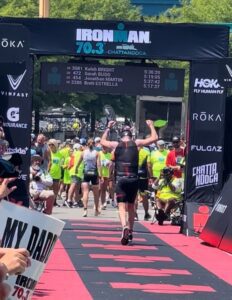
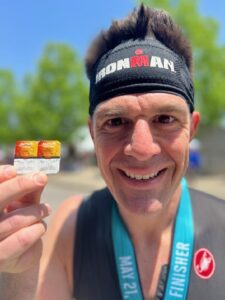

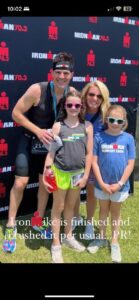
“The lens made the biggest difference on the run as I was not squinting the whole time. I feel this allowed me to keep my heart rate under control a little better. Not to mention my head didn’t hurt. I just can’t run in glasses as I sweat so much. Second best was how amazing they were on the ride. There were a lot of shadows on the road and they did not bother me at all. I seriously can’t thank you guys enough and none of this would have been possible without ALTIUS.”
We look forward to following Michael on his journey as he continues to compete and crush his goals!